

hoa license plate recognition camera
HOA License Plate Recognition Cameras
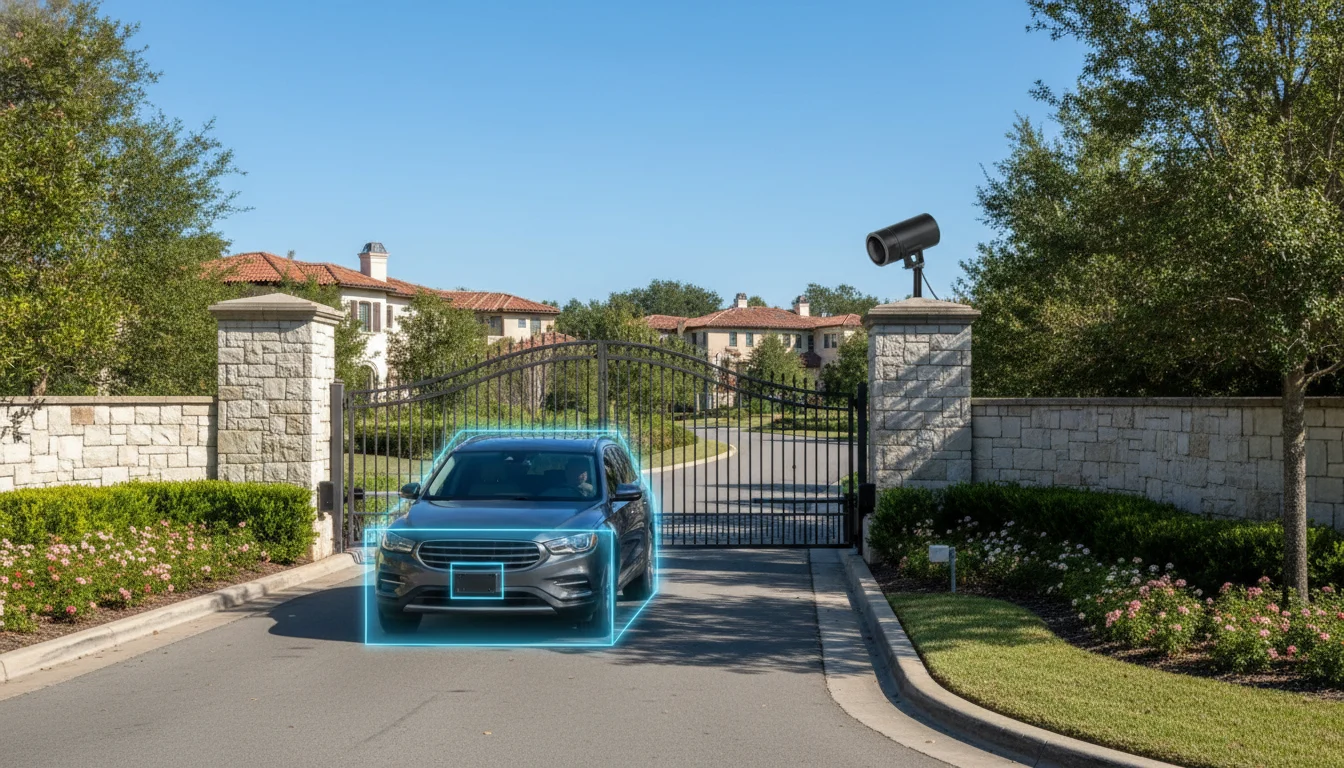
Automatically log every vehicle that enters your community, flag unauthorized plates in real time, and give your board a complete, searchable activity record — without wiring, permits, or IT staff.
GET FREE AI ASSESSMENT See PricingWhy HOAs Install License Plate Recognition Cameras
Most HOA parking problems share the same root cause: no one knows which vehicles belong and which do not. Paper permits are easy to lose and hard to verify. Manual patrols are expensive and inconsistent. LPR cameras solve both by logging every plate automatically — creating a continuous record you can search, filter, and act on.
🚗 Automatic Vehicle Logging
Every vehicle that enters is captured — plate number, vehicle description, date, time. No staff action required. Searchable records go back as far as you need them.
⚠️ Real-Time Violation Alerts
Set a watchlist of flagged plates — trespass notices, repeat violators, stolen vehicles. When a flagged plate is detected, management receives an instant notification.
✅ Resident Whitelist
Registered resident vehicles are automatically recognized and cleared. Only unregistered vehicles are flagged, reducing false alarms and keeping enforcement focused.
🔒 Evidence for Enforcement
Timestamped plate images give HOA boards the documentation needed to issue notices, authorize towing, or resolve resident disputes with verified records.
☀️ No Infrastructure Required
Solar-powered cameras install on existing gates, poles, or fences — no electrician, no trenching, no board approval cycle for construction. Live within days of receiving hardware.
📊 Board Dashboard
Management company and board members access a shared cloud dashboard — searchable activity logs, violation flags, and vehicle history reports from any device.
PLACA.AI GuardCam: Built for HOA Communities
Solar-Powered, 4G-Connected
No wiring, no network access, no IT coordination. Mount on any surface with an unobstructed view of incoming vehicles.
Radar-Assisted Plate Capture
Built-in radar detects approaching vehicles and triggers the camera before they reach the frame, ensuring clean plate captures at community entry speeds.
IP66 Weatherproof Housing
Rated IP66 for dust and water. Operates in rain, direct sun, and overnight temperatures. Night vision IR delivers readable plates in complete darkness.
Multi-Community Management
Management companies overseeing multiple HOA communities view and manage all locations in a single dashboard — no account switching.
Customizable Alert Rules
Set watchlists, whitelists, and timed alert windows — alert only between 10pm–6am for unregistered vehicles, or always alert for trespass-listed plates.
Searchable Activity History
Look up any plate and see its full entry history. Filter by date, time, or vehicle. Export records for board meetings or towing documentation.
What to Look For When Choosing an HOA LPR Camera
Solar vs. Wired
HOA installations often face a chicken-and-egg problem: running electrical power requires permits and contractor work. Solar-powered LPR cameras eliminate this — no electrician, no permits, no trenching. For most HOA gate and entry-point locations with reasonable sun exposure, solar is the right choice.
4G vs. Wi-Fi Connectivity
A camera on the community’s Wi-Fi goes offline whenever the router has issues. 4G-connected cameras operate independently of the community’s network, with carrier-grade uptime.
Night Performance
HOA entry points see complete darkness at night. A camera without IR illumination will miss a significant percentage of plates. Verify accuracy claims include low-light performance.
Cloud Storage and Searchability
Local storage (SD card or DVR) requires physically retrieving footage. Cloud-stored, searchable plate logs let management look up any vehicle from anywhere, instantly.
Alert Configuration
Blanket alerts for every unregistered vehicle create alert fatigue in large communities. Look for configurable time windows, watchlist-only alerts, or threshold-based notifications.
Estimate Your Community’s Cost
Use our HOA security cost calculator to estimate camera system cost for your community size and entry configuration.
HOA LPR Camera:
Why buyers use PLACA for vehicle access and parking workflows
PLACA is designed for private-property operations where the buyer needs practical vehicle recognition, not a broad surveillance network. The implementation review starts with the site layout, existing cameras or gate equipment, vehicle flow, privacy expectations, and the workflow each team needs to improve.
Existing infrastructureDesigned to evaluate current gates, cameras, lanes, and parking workflows before recommending new hardware.
Private-property fitBuilt around HOAs, apartments, schools, self-storage, towing, commercial sites, and managed parking operations.
Governed accessSupports buyer conversations around role-based access, retention, audit trails, and resident or customer transparency.
Assessment firstPLACA reviews lighting, lane geometry, camera angle, network reliability, and operational goals before deployment.
Frequently Asked Questions
Why buyers use PLACA for vehicle access and parking workflows
PLACA is designed for private-property operations where the buyer needs practical vehicle recognition, not a broad surveillance network. The implementation review starts with the site layout, existing cameras or gate equipment, vehicle flow, privacy expectations, and the workflow each team needs to improve.
Designed to evaluate current gates, cameras, lanes, and parking workflows before recommending new hardware.
Built around HOAs, apartments, schools, self-storage, towing, commercial sites, and managed parking operations.
Supports buyer conversations around role-based access, retention, audit trails, and resident or customer transparency.
PLACA reviews lighting, lane geometry, camera angle, network reliability, and operational goals before deployment.
Do HOA LPR cameras require a permit?
In most jurisdictions, solar-powered cameras on private HOA property do not require a building permit. Requirements vary by municipality. Consult your HOA attorney for state-specific guidance.
How many cameras does a typical HOA need?
One camera per active vehicle entry point. A single-entrance community needs one. A community with a main gate and secondary entrance typically starts with two. Our free assessment includes a camera placement recommendation based on your community layout.
Can PLACA.AI integrate with our existing gate system?
Yes. PLACA.AI GateCam allows authorized vehicles to trigger automatic gate opening via plate recognition. Compatible with most modern gate controllers. Contact us to verify compatibility with your specific hardware.
What happens when an unregistered vehicle enters?
The vehicle is logged with plate image and timestamp. If it matches your watchlist, management gets an instant alert. Otherwise it appears in the activity log for review and enforcement action.
How does PLACA.AI compare to Flock Safety for HOA?
Flock Safety is primarily designed for law enforcement partnerships. PLACA.AI GuardCam is designed for private property enforcement and HOA parking management. See the full Flock Safety comparison.
Related: GuardCam Product Page | Resident Solutions | HOA Parking Enforcement | vs Flock Safety | Cost Calculator
GET FREE AI ASSESSMENT
We review your community layout, entry points, and enforcement goals — then recommend the right camera configuration with transparent pricing.
Book Your Free AssessmentNo commitment required. Assessments typically take 20 minutes.
HOA LPR Resources & Guides
Everything HOA boards and property managers need to know about license plate recognition.
Flock Safety vs. PLACA.AI for HOAs
Independent analysis of Flock Safety for HOA communities.
RoadCam & RadarCam Camera Selection
Need a stronger LPR camera path for gates, private roads, campuses, parking, or multi-lane entrances?
Compare RoadCam & RadarCam options | RoadCam | RoadCam Pro | RadarCam Lite | RadarCam | Get a camera recommendation
Privacy-First HOA Security Resources
Review community-controlled LPR, camera data retention, resident trust, and closed-loop HOA security workflows.
Privacy-first HOA security systems | HOA LPR camera questions | Closed-loop cameras | Flock alternative for HOAs
HOA License Plate Recognition Software for Vehicle Management
HOA license plate recognition is more than a camera at the entrance. For a community association, it becomes vehicle management software: a way to register resident vehicles, verify visitor access, document parking events, and investigate incidents without relying only on shared gate codes, stickers, or manual patrols.
Placa.ai helps HOAs connect plate reads to the workflows boards actually manage: resident vehicle lists, guest permissions, permit rules, parking compliance, and privacy-first event logs.
HOA Vehicle Management Software
An HOA vehicle management workflow should answer three questions quickly: who owns the vehicle, whether it is allowed on the property, and what happened when it entered or parked. License plate recognition gives the board a searchable record of vehicle activity while reducing manual spreadsheet updates and windshield sticker checks.
HOA Visitor Management Software
Visitor management works best when guests can be pre-approved, time-limited, and reviewed after an event. Instead of distributing a shared gate code, an HOA can authorize a visitor plate for a specific window and log the arrival automatically.
HOA Parking Permit Management
For communities with assigned spaces, guest lots, towing rules, or overnight restrictions, LPR can support parking permit management by matching a plate against the approved resident or visitor list. This gives managers a cleaner way to flag repeat violations and document enforcement decisions.
Privacy-First HOA LPR
Privacy-first HOA LPR should include clear signage, role-based access, documented retention windows, export controls, and limits on who can review vehicle history. Boards should use LPR to manage private-property access and parking, not to create unnecessary surveillance practices.
| HOA Workflow | Manual Method | Placa.ai LPR Workflow |
|---|---|---|
| Resident vehicle registration | Forms, decals, spreadsheets | Plate-based vehicle records and searchable event history |
| Visitor parking | Guest passes or shared gate codes | Time-limited visitor plate permissions |
| Parking compliance | Manual patrol and photos | Timestamped plate events and violation review |
| Gate access | Fobs, cards, keypad codes | Vehicle-specific entry decisions tied to a plate |
HOA LPR FAQs
What is HOA vehicle management software?
HOA vehicle management software helps a community register resident vehicles, manage visitor permissions, review parking activity, and document vehicle events. License plate recognition adds automated plate reads and searchable logs to that workflow.
Can HOA license plate recognition manage visitor parking?
Yes. An HOA can use LPR to recognize approved visitor plates during a specific access window, log arrivals, and review visitor parking activity without relying only on paper passes or shared gate codes.
How does LPR help HOA parking permit management?
LPR helps compare parked or entering vehicles against approved resident, visitor, or permit lists. This can support fair enforcement by giving the board timestamped evidence before warnings, fines, or towing decisions.
Is HOA LPR privacy friendly?
HOA LPR can be privacy friendly when it uses clear retention limits, role-based access, transparent signage, documented policies, and limited data sharing.
Reference: Automatic Number Plate Recognition – Wikipedia
Related planning resources: how HOA security can earn resident trust and HOA security without mass surveillance.
Related planning resources: privacy-first LPR for HOAs without police network access, privacy-friendly LPR for gated communities and resident concerns about neighborhood cameras.
HOA Towing and Parking Enforcement Workflow
HOA boards that use LPR for parking documentation often need a towing partner or private-property enforcement process. Placa.ai TowCam helps towing companies scan plates, document patrols, and support permit-based parking enforcement for communities.
How Does License Plate Recognition Work in HOAs?
In an HOA, license plate recognition works by turning a vehicle arrival into a structured access or parking event. A camera captures the vehicle, AI reads the plate, the system checks that plate against resident, visitor, vendor, or enforcement rules, and the event is logged for board or manager review.
- Capture: A gate, road, or parking camera records the vehicle as it enters or parks.
- Read: AI/OCR identifies the license plate and creates a timestamped plate event.
- Compare: The plate is checked against resident, visitor, vendor, watchlist, or permit rules.
- Act: The system can open a gate, alert a manager, flag a parking issue, or simply log the visit.
- Review: Authorized users can search reports when there is a violation, incident, or board question.
Should My HOA Install License Plate Cameras?
An HOA should consider license plate cameras when it needs better vehicle accountability than gate codes, decals, manual patrols, or paper visitor passes can provide. The decision should be based on the community’s actual problem: unauthorized parking, gate code sharing, repeat violations, private-road access, visitor overflow, or incident review.
| Install LPR if… | Do not install yet if… |
|---|---|
| The community has recurring unauthorized parking or gate access problems. | The board has not defined a written purpose for the cameras. |
| Residents, visitors, vendors, and enforcement rules need clearer audit trails. | There is no retention policy, access policy, or resident notice plan. |
| The HOA wants vehicle-specific access instead of shared gate credentials. | The camera location cannot reliably capture plates without overcollecting unrelated activity. |
| The board wants searchable evidence before warnings, fines, or towing decisions. | The system would send data to outside networks without board approval or transparency. |
What Are My Privacy Rights With HOA Cameras?
HOA camera privacy rights depend on state law, governing documents, camera location, vendor contracts, and the board’s written policies. Residents should be able to ask what the cameras collect, why the HOA collects it, who can access it, how long it is retained, and whether plate data or footage is shared with outside parties.
A privacy-first HOA camera program should include clear signage or notice, role-based access, defined retention windows, limited exports, vendor data controls, and board-approved rules for law-enforcement requests or third-party sharing.
Resident and Board Privacy Checklist
- What is the camera’s purpose: gate access, parking compliance, safety review, or all three?
- Where are cameras placed, and what areas are intentionally excluded?
- How long are plate reads or images kept?
- Who can search, export, or delete records?
- Is data shared with police, vendors, insurers, towing companies, or any third-party network?
- How can residents review the written policy or ask questions before deployment?
HOA License Plate Camera FAQs
Can an HOA record license plates?
Many HOAs use cameras on common areas or private roads, but the rules depend on state law, governing documents, notice, camera placement, and how the data is used. Boards should document the purpose, retention period, access rules, and sharing limits before deployment.
Can an HOA use LPR for visitor parking?
Yes. LPR can approve visitor plates for a defined time window, log arrivals, and help managers review overstays or unauthorized repeat parking.
Can an HOA share license plate data with police?
That depends on the HOA policy, vendor contract, resident notice, and applicable law. A privacy-first setup should require board-approved rules for external sharing and should avoid automatic data sharing without clear consent and governance.
How long should an HOA keep license plate camera data?
The retention window should be short enough to reduce privacy risk but long enough to support legitimate access, parking, safety, or enforcement review. Boards should publish the retention period and apply it consistently.